




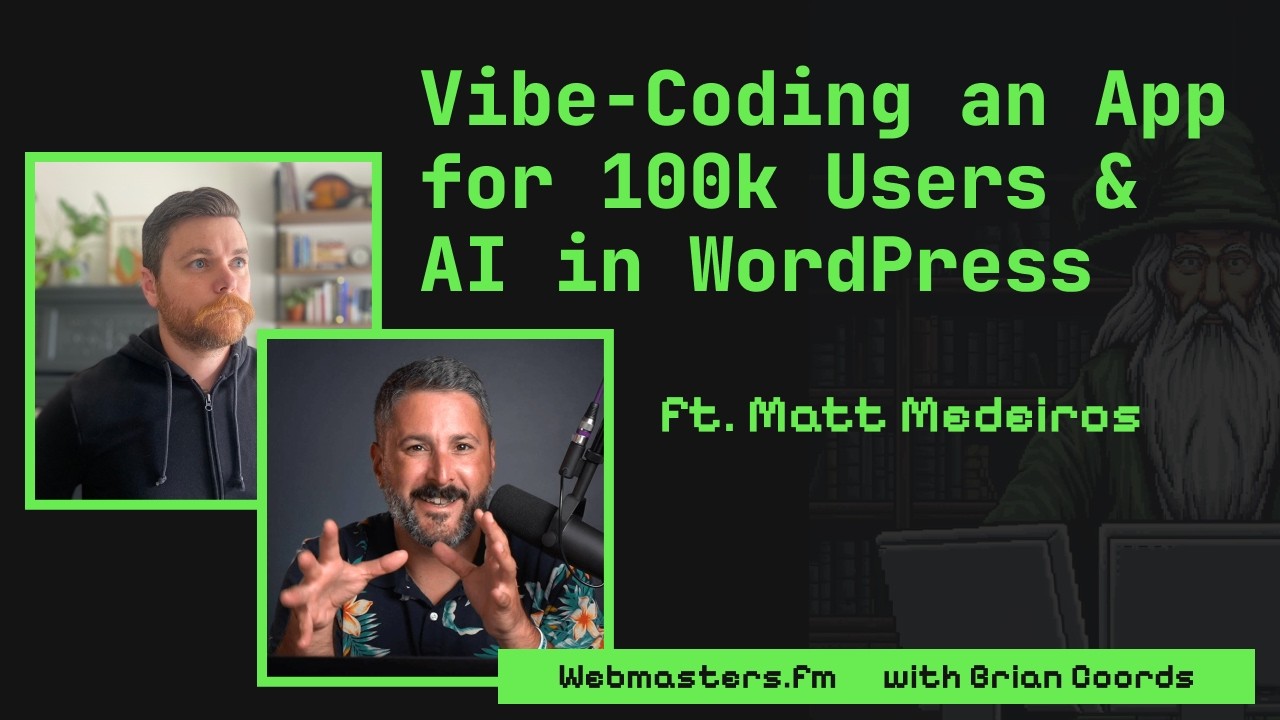
In this conversation, Matt Medeiros discusses his recent experience creating a community-driven app during a significant blizzard, leveraging Cloudflare and Cloud Code for development. He reflects on the impact of AI on software development, the importance of trust in tech, and the evolving landscape of web development tools, particularly in relation to WordPress. The discussion also touches on the future of websites in an AI-driven world and the potential for more competition in providing tech solutions to local governments.
Links
Chapters
00:00 Introduction and Celebrity Status
08:52 Technical Choices and Cloud Platforms
13:15 The Future of Software Development
19:02 The Importance of Trust in a Competitive Landscape
23:50 The Evolution of WordPress and AI Integration
28:45 The Role of AI in Development and Trust Issues
Transcript
Brian Coords (00:00)
Matt Medeiros, welcome to Webmasters FM.
Matt Medeiros (00:02)
I gotta be the number one returning guest now. I think I said that last time.
Brian Coords (00:06)
I think
you’re the only returning guest.
Matt Medeiros (00:09)
Okay, well, I’ll take it. Thanks for having me, Brian.
Brian Coords (00:13)
Yeah, you’ll lose that honor, I think, because I know Mike McAllister released a bunch, he’s releasing a bunch of WooCommerce stuff for Olly and I gotta talk to him about that, but other than that, I think it’s just you. Yeah, I don’t know. You still on the Twitters these days or are you somewhere better?
Matt Medeiros (00:22)
Never heard of Mike Mc… Mc… McAnister?
No,
no, there’s no place better than an extreme, I’ll tell you. ⁓
Brian Coords (00:34)
You
Yeah,
it’s the worst outside of every other one, which is even worse. Yeah. Well, I don’t want to go too much into detail about this, but you’re kind of a celebrity now. I saw you on the local news, not my local news, your local news, for an app that you vibe coded. And I think people can watch the full video of what you built there, but I thought it was…
Matt Medeiros (00:42)
Yeah.
Mm. Mm.
Mm-hmm.
Brian Coords (00:59)
It’s the first time I’ve seen somebody, of vibe code, which we could talk about if that word even makes sense, but it’s the first time I’ve seen that where it actually shipped and impacted real people. A lot of times it’s like, I built this thing for myself and then I stopped using it after a week, but this was a real situation. So maybe you could like give the like high level view of what you built. And then I kind of want to talk about how you built it. Cause I think that’s the, the part I’m most curious about.
Matt Medeiros (01:22)
Yeah, that whole like making money with vibe coding or with AI tooling, that voice of yours is always in the back of my head because you challenged that. You challenged me with that phrase like a couple years ago when I first started getting into this stuff with like Bolt and Replet, which we’ll talk about. But in this particular instance, for those, the brief overview is ⁓ last week, a week ago.
The Northeast was hit with a pretty sizable blizzard bigger than the blizzard of 78, which if you’re from this area is the blizzard that everyone always references like every time it snows around here. Whenever we get any kind of like one over one foot of snow coming, the local news is always playing like, remember the blizzard of 78 where, you know, they had like 36 inches of snow. Where I live got officially 41 inches of snow. 40 or 41 was the official count in my area.
Brian Coords (01:54)
Mm.
Matt Medeiros (02:10)
And it just like literally put everything to a halt. Like we weren’t going anywhere. There was no driving anywhere. There was no cleaning this in a couple of hours. This took days. And what started to happen was people were wondering like when they were actually going to get help from the local city and the plow trucks and whatnot and the National Guard ended up coming in and not just my city but surrounding cities. And
One, I think it was like Tuesday night, the storm hit Sunday into Monday through most of Monday was the blizzard itself. Then Tuesday night, I saw some chatter on Facebook about wouldn’t it be great if the city had like a list of streets that were getting plowed and like what the status is, like some kind of visibility into the cleanup process. So then, you know, I had nothing else to do, Ryan. Tuesday night, literally can’t leave the house. The street was three and a half feet of snow.
with drifts of like five feet. So I was like, hey, let me just whip up something in Claude code. Let me just test it locally. See what, see if I can get this thing working in a timely manner. So I built something, you know, very, you know, very MVP, very slim, very ⁓ lightweight. You just punch in your street and say, is it plowed or not plowed? And it plots it on a map. And then you can visually see on the map.
whether the street was plowed or not plowed. And we can get into how I iterated on it and stuff like that. But I just sent it to one of the people that was mentioning it was the former mayor of our city. ⁓ have no relation to him or anything and I just sent him it and I said, hey, I just made this real quick. Made it in Cloud Code, launched it on Cloudflare. Pretty great stack, nice little combo there. And ⁓ sent it to him and like, what do you think? And all he did was share it on his Facebook page. And then from there,
Brian Coords (03:39)
Mm-hmm.
Matt Medeiros (03:54)
started to take a life of its own where people started sharing it, people started using it, which was the, you know, the important part. And then in the morning, the city had the police department had recommended it. The city officially started recommending it. Then I started getting interviewed on all these like news channels and whatnot, and people were using it. So, yeah, it was a pretty surreal moment. And it was probably the largest thing I’ve ever launched in terms of like.
size wise, like people like the traffic and stuff and like watching CloudFlare wondering is this thing going to just melt down as people are using it? thankfully it didn’t. And it was a pretty fun experience.
Brian Coords (04:21)
Yeah.
Were you worried about like costs racking up? ⁓ when you look at that traffic, were you thinking, what am I paying for this?
Matt Medeiros (04:36)
Yeah, at one point, when I started to see the page views, I started the worker processes, which is, in layman’s terms, it’s tracking everything that’s happening on the worker of Cloudflare. within the hour, it was at 15,000 requests, and I was like, huh, I wonder what’s gonna happen with this. And then it went over millions, right? But still within the plan that I’m on on Cloudflare.
So, yeah, thankful for that. the pricing didn’t, you know, I didn’t have to worry about the pricing too much. You over the course of like the storm cleanup, it was like 300 to 350,000 page views altogether to the app in the span of like 72-ish hours. Yeah, millions of requests to the worker, billions of rows read in the database. Yeah, it was like the craziest.
Brian Coords (05:23)
Mm-hmm.
Matt Medeiros (05:27)
thing I’ve ever launched. ⁓ A couple other towns reached out and they’re like, we have this too? And I was like, sure, like as long as you know I’m just a dude trying to help people right now. Like I’m not like, you know, I’m not your tech hotline to this stuff.
Brian Coords (05:36)
Yeah.
But so I guess when I first saw that you posted it, I thought you were like scraping city data and just making it more palatable. Like, the city’s tracking it, but you were crowdsourcing the information. So it wasn’t just like a static page or something. Like people were selecting their address and updating it and you’re saving that to a database. So like that’s actually a little more complex than I thought you had built.
Matt Medeiros (06:02)
Yeah, so source the street data from the state GIS database system, which is open API that you can access, pull that data down. I noticed that some people, like a few people said like, my street’s not on the list, but maybe one or two and one or two in the other towns that I launched it in, but largely they were all there. And like the GIS database actually.
So in my town it was like 1027 streets I think is what I had. And it even includes off-ramp, they include off-ramp and on-ramp sections in that GIS data. So yeah, it was that. And I did a majority rules, because I was thinking to myself, what’s the fastest way to launch something like this that’s gonna get the biggest impact? And I did a majority rules kind of thing where if this, you know,
Brian Coords (06:30)
Mm-hmm.
Matt Medeiros (06:47)
100 people on the street and 51 people say it’s plowed and 49 people say it’s not plowed. Then it’s going to make the street green and say that it’s plowed. mean, it’s the best I could do with like literally within an hour. And then I eventually like as I saw the discourse, I mean, it was crazy, man. was like in the Facebook groups, it was just like all these people screenshotting this app and like sharing it and being like, oh, my streets are plowed, my streets plow, my streets are plowed and like seeing everybody like using it and telling people you have to vote or it doesn’t it doesn’t work and like
Brian Coords (06:55)
Mm-hmm.
Matt Medeiros (07:16)
Seeing how some people understood it and some people didn’t was wild. And then I introduced, as long as you’re sharing location with your browser, a couple hours later I implemented a little pinpoint on the map that says, this is where you made your report. So if you had a long stretch of a street, which obviously many are, many miles some of them, or if it were green, but on one side you saw a bunch of red being reported,
Like that was the best way to be like, okay, reports are coming in that it’s not plowed. And in this section right here, you can see a bunch of red dots essentially where people have reported this. yeah, so that was like the fastest way to launch something like this and then interfaced with a friend of mine on the police, at the police station to help him build out some other stuff behind the scenes so that they could ⁓ get better reporting and actually use it with people.
with boots on the ground.
Brian Coords (08:07)
And I feel like when we last talked, I don’t know when it was, everything feels like forever ago now since I think December of 2025 is that pivotal moment, know, that was the everybody, you know, changed their minds on AI and everything like that. But back then it was like Lovable Bolt and Replet were the names that I would hear a lot and you were experimenting with this.
been a huge Cloud Code fan for the last like maybe five or six months. I feel like I do everything in it. I use it for almost everything I do. Would you have done this through a platform like that? Do you still use those types of platforms? You’re obviously more technical than most people that might be spinning stuff up, so you’re probably a little more comfortable in something like a Cloud Code, but where do you see those platforms now in your workflows and…
and how was the switching to cloud, know, cloudflare and claud code. mean, that’s some technical stuff.
Matt Medeiros (08:57)
Yeah, mean, the cloud the CloudFlare stuff I’ve been using for a while and really getting comfortable with their like ecosystem. And yeah, I love it over Amazon. I’ve never been a fan of Amazon, although I haven’t really used like any kind of AWS stuff for a few years. But CloudFlare is just very simple. And I find it very simple and straightforward and well documented. So even AI knows how to understand like what services come together.
However, if this had happened like a year ago, I mean, obviously, AIs evolve greatly in one year. Well, let’s just say like everything were even. I probably would have been on Replet, which it probably would not have been able to survive this. Actually, I know it wouldn’t have by any stretch of the imagination. ⁓ So I do a lot like 99 % of things I do now are in Claude. However,
Brian Coords (09:35)
Mm-hmm.
Yeah.
Yeah.
Matt Medeiros (09:50)
just to make the case for your question is this morning I was actually working on something, more of like a utility app for our marketing team at Gravity Forms. And I’m using Replet for that because I, from a scale, a, how do you, like a business continuity kind of thing, I just want it to live in Replet. That way we can have it in Replet if I’m not here or something happens.
Brian Coords (10:07)
Yeah.
Matt Medeiros (10:13)
It’s just like a utility app. We’re just using it for like a certain thing. Then it’s all just contained right here. Let’s just let it live right there. That way I’m not, hey, let’s Cloudflare sign up and I’m building everything on locally on Cloud Code. So I think that there’s a world where folks that are like internal at an organization, I can see those tools becoming very popular for those like internal organizations, especially from a non-technical standpoint. But Cloud Code has just been phenomenal.
And codex as well, like codex on the terminal has been pretty good as well. So I’ve been bouncing between those two.
Brian Coords (10:46)
Have you opened Codex yet? I, well, you said you bounced between the two. I just feel like Cloud Code, I’m like, this is enough right now. I don’t need to learn another thing. I’m not hitting walls with it. I’m not hitting gaps where it’s not accomplishing what I want. Is it a step change better, like some people say, or is it just more of the same?
Matt Medeiros (10:55)
Yeah.
So I’ve actually just been using it for, so I just like really using, I’m trying to figure out the best way to phrase this, like I use Cloud Code in the terminal for a lot of things, like all the ideating, creative, and thought process stuff. And I think I’ve seen you talk about this before as well, it’s just like organize all this stuff locally on my machine with Markdown files and.
Brian Coords (11:19)
Mm-hmm.
Yeah.
Matt Medeiros (11:29)
folders and in my brain works really good with this like folders files when I need to reference something I know it’s in this folder and I can either double click on it with my mouse or While I’m in the terminal I can just say reference this folder to understand this so what I’ll do often is Especially when I was like building this stuff out I honestly don’t often hit the clod code max
I am on the max plan, only the $100 a month plan. ⁓ I don’t often hit that limit, but I did a few times here. So then I just bounced over to Codex and just did like other thinking pieces. Like while I was waiting for Codex to cool down, I would then switch to Codex and then just do some other things like run through this code and document it. Help me think about this other idea. And then truly like the…
Brian Coords (11:56)
Mm-hmm.
Yeah.
Yeah.
Matt Medeiros (12:18)
the code output of Claude has for me anyway been the most error free compared to everybody else. So I just bounce between the two and I need to kind of like balance the tokens if that makes sense.
Brian Coords (12:29)
Yeah. Yeah. I mean, it’s like we’ve, think we’ve all gotten the lesson beaten into us, which is like, if you’re struggling with it this week, they’ll have solved it by the next week. And so it’s, it’s hard, but I think the thing you said about like packaging it up for a team is really important. have a tool that I
Matt Medeiros (12:38)
Yeah.
Brian Coords (12:45)
Have been iterating on over the last few months where a new version of WooCommerce comes out. There’s a couple of hundred PRs and I need to review all of them and figure out what’s the important stuff to communicate. What’s the stuff that’s going to affect people. That’s a lot of context, hundreds of PRs full of comment threads. Then you find out a later PR cancel that one out because they fixed a thing and I need all of that working together. So I have some scripts I’ve done that uses Claude skills and maybe it runs some Python to fetch things or the GitHub API and it does all this stuff. And now I’m looking at
like how do I give this to a team member to use? Like how do I, like I could put it in a repo and be like go here, install this and stuff, but like being able to just like host it somewhere and be like you can log in and you can just do all this stuff. I actually do think that that’s gonna be kind of a valuable thing, but I assume we’re gonna see some.
you know, more products to solve it. I just feel like I don’t hear about Replit and Lovable nearly as much as I was six months ago, you know.
Matt Medeiros (13:44)
Yeah, I mean, I don’t know, maybe just be my algorithm. I still hear and see a lot of people using Replet and and and, you know, loving it. No pun intended. But like Bolt, whereas Bolt is where I had my first fascination of like, oh, my God, look at this in the browser. And. You know, you know, they seem like nice people, but I never touch it anymore. I know they get a bunch of money. You know, I don’t know what’s happening with them. Lovable, same thing. Lovable, I actually never used, never got into it because Replet was fine.
Brian Coords (13:59)
Yeah.
Matt Medeiros (14:11)
But I was having, you know, it’s funny, like, when you have, like, these moments and people are, seeing me, like, on news, on the news and, like, getting shared on Facebook and stuff. They’re like, I hope you’ve, like, patented this idea and you’re going to make a bunch of money off of this stuff. You know, so folks like you and I who are in this cycle, like, we all see, like, the cost of software going to zero and, like, the natural instinct.
Brian Coords (14:28)
Mm-hmm.
Mm-hmm.
Matt Medeiros (14:34)
is to be like, well, everybody’s gonna be able to do this. Like, is nothing, you know, I say this is nothing special. Because everyone’s gonna have this ability. In fact, I kinda want everybody to have this ability, I guess. And I think in like a year’s time, or two years’ time, like literally everybody will be able to do it. But people are just, still look at it, and they’re going, no one’s gonna be able to do this. Like, only like real technical people can do this.
You know, it’s just that weird balance of being in this mode where people are like, my God, like you’ve got a business here. And side note, maybe I’ll try it because you know me, Brian. I am still trying to make that dollar off the off the side of it. If there’s a business opportunity, I might try to pursue it. And I I do have some towns lined up this week that actually want to talk to me. So it could be a thing, but it also could not. It’s whatever. But it’s also like we’re in this weird balance mode of like.
Brian Coords (15:04)
Yeah, if there’s a business, you can start. You’ll do it.
Matt Medeiros (15:20)
Okay, fine. I’m a power user. I’ll admit it and I can come in and I can figure this stuff out But a year from now two years five years from now. What does that landscape look like? You know, that’s the thing. think we’re all wrestling with right now
Brian Coords (15:32)
Well, I think both of our day jobs we work at software companies. So you’re obviously keenly aware of what happens if the cost of software goes to nothing. I know WooCommerce is kind of unique because that’s not, we don’t make most of our money selling code, you know, like we have a marketplace, you can buy plugins, but that’s not what pays the bills. There’s other things that.
pay the bills other than trying to get people to buy a chunk of code from you. I think Gravity Forms probably has a little diversity in that case too. But like at the end of the day, it is kind of a scary thing to think about the fact that this could and probably should be freely available to most people. But when I think about like, making a business of your app, what’ll make it hard is not the software. Like the software is pretty easy before, you know, it was easy before, it’s just, you know, 100x easier now.
The hard part will be, now I got local governments. Now I got, you know, contracts and vendors, you know, forms I got to fill out and all the human bureaucracy that goes around it. And this is kind of an interesting week for government and AI anyway, with everything going on with Anthropic and, you know, the Department of Defense and everything like that. But I wonder when you look at it, the generating code seems to be doable, but is AI going to make…
dealing with, you know, getting government contracts any easier for you? Or is that gonna, would that still be something that, you know, is just gonna require time and expertise?
Matt Medeiros (16:53)
I presume it will. I think the most interesting thing that I learned through this was that nobody, again, you and I are technical. Even going back to building websites for clients, you knew how to password protect something. You knew how to lock down a server and not put stuff in the public directory, like basic security principles and all this stuff.
Brian Coords (17:15)
Yeah.
Matt Medeiros (17:17)
I launched this. only knew one person in the police department. Now, granted, he’s one step away from the police chief, but no one else reached out to confirm who I was and what I was doing with the software. Like no layer of validation. Same thing from the towns over who I knew no one. They just messaged me on Facebook and they’re like, hey, we saw what you’re doing in your city. Can you help us do the same? Because we need it. And I’m like, sure. And these people are just
blindly trusting me with tens of thousands of their citizens going to this site. Brian, at any stage in the game, I could have put a little QR code to send me Bitcoin. I could have started, I could have said like, hey, if you want your street plowed, click here for $5 and somebody will come and click. And I could have, like, nobody, nothing. So like, there’s like this level of trust. And I think that this is, you know, again, that future of like, what happens when everyone can do it?
Brian Coords (17:45)
You
Yeah.
Yeah.
Yeah.
Yeah
Yeah.
Mm-hmm.
Matt Medeiros (18:12)
When everybody can do it, does that mean, and I don’t have the answer for this, but when everyone can do it, or at least in the next five years, does that mean that there’s more people like you and I with solutions, let’s say for a local government, who’s not gonna have the talent internally to do it? And so does that mean there’s just more competition to sell this kind of service to, whatever it is, websites or apps? And if so, is trust in the business the most important thing?
Like can you, just because everybody can now do it, who’s gonna win? Is it the trusted person and how do you deliver on that trust? How do you exercise and demonstrate you’re a trustworthy person or you really know the market? I mean, this is stuff that I talk about on my podcast a lot, but to actually live and breathe it right now where all these other towns and cities who have reached out to me, they’re like, yeah, we wanna talk to you about this. it’s in the back of my head, I’m like, well, why? It’s because I demonstrated it.
Brian Coords (18:42)
Hmm.
Matt Medeiros (19:02)
and they recommended me, right? So it’s like the old school like word of mouth thing is still working. And how is that amplified in the future? I have no idea.
Brian Coords (19:03)
Yeah.
Yeah.
Yeah. And I think that’s a good point, which is, you know, it’s, I’m sure you’ve seen the things where it’s like, ⁓ Sam Altman tweets, all the skills you need in the age of AI. And it’s just the same skills you always have needed, which is, you know, networking and project management. And you know, it’s, it’s all of that really doesn’t change and all of it seems, you know, seems pretty much the same, but it’s just faster and everything is changing quick more quickly. And you aren’t really sure what are the pieces that where the value even is going to be.
Matt Medeiros (19:22)
Right, yeah. Yeah, yeah, Yeah.
Brian Coords (19:39)
But I want to pivot and the question I want to ask you, which I have to imagine somebody asked you at some time, which is, why didn’t you build this on WordPress? Why didn’t you ask Telex to make you a block for your blog to handle all of this stuff? Why not WordPress?
Matt Medeiros (19:51)
Yeah, yeah, yeah.
Yeah, mean, for me, in this particular thing, it was going into the mindset of single page app, cloud flare worker, as lightweight as possible. ⁓ And yes, I know I could have done some kind of like WordPress back end with a static front end, but I see people asking about these questions on Facebook. I’m like, well, how quickly can I do this? Because I’m also, you know me really well.
Brian Coords (20:05)
Yeah.
Matt Medeiros (20:18)
There’s always like a thousand different little projects going on. do I, how many hours do I really want to put into this? I want to put one hour into this. That’s what I want to do. I want to put one hour into this. And what’s the fastest route there? And it was, you know, Cloudflare, you know, worker and the database back and whatever. But the whole point was like, I don’t want to even mess with with WordPress. I don’t want to build a directory. I don’t want people logging in. I’m not going to do any extra content around it. So like, let’s just get it out out the door.
as fast as possible. Now, there could be a world in the future where you can say WordPress, lightweight backend, just pages, launch it, let’s go, I’m down for that, but we’re just not there yet.
Brian Coords (20:56)
have you looked at WordPress 7.0 and the AI tools? And do you have kind of a general sense of, you think, you know, like on the one hand you’re saying WordPress just wasn’t the right tool for this job. And I think that makes a lot of sense. like I wouldn’t have done it on WordPress either. It’s just a question I had to ask. It’s not really the tool for that job. WordPress is a tool for other jobs. Do you think that where WordPress is headed with 7.0, do you think it’s…
going in the right direction and it’s making sense for what WordPress is good for, or do you have some concerns about it?
Matt Medeiros (21:25)
Yeah, I’ve looked at it. I do have some time blocked off at the end of the week to like dive into it and maybe do a video on what I think I can do as a power user with this stuff right now. Again, like I just think from a speed standpoint, WordPress is still not there, obviously. But yeah, think everything from what I’m reading, from what I’m reading, yeah, I’m really liking this.
direction. I think I said this on the pod, your podcast last time was, and maybe it’s just a me thing, right? Maybe I just haven’t found it yet, but especially building plugins inside of WordPress, it just doesn’t feel as, it still feels like a clumsy workflow versus just like the live nature of just a single page JavaScript app, watch this stuff update and I can have one window open and the other my terminal and I can see this stuff.
Brian Coords (22:02)
Yeah.
Matt Medeiros (22:13)
happening in real time, it just seems so much faster that way. But I do want to build a better, I do want to experience that kind of instant gratification, I don’t know if that’s the right phrase, but I want to feel that with WordPress. And hopefully all of this tooling helps us get to that point, you know, in my opinion.
Brian Coords (22:30)
Yeah, I a few theories on this. One is that there is no WordPress version of what CloudFlare and other hosts do, which is like pay zero and pay as you scale. I mean, you could do a free blog on WordPress.com and that’s kind of…
the original version of that, right? Like you can get your free blog and as you get more traffic or you wanna take the ads off, then you can pay more and scale it. But there’s not really like a, I can’t just run a command and it shows up on a WordPress site somewhere the way that I can with CloudFlare or Vercell or some of these. I think that’s a huge gap that I’m assuming somebody’s working on. And I think the other big thing is like the only time WordPress ever makes sense is if you wanna build the same thing twice.
which is you want to build it for the front end person to do it. And you want to build the backend editing situation for it too. So, you know, block is a good example where there’s the block on the front end is what the person sees when they read the blog post. And there’s the block on the backend where the person can edit the content and all that sort of stuff. And that’s how WordPress is. It’s front end stuff coming out and a settings page on the backend. Every gravity forms is like that. You know, everything works in that way. And so if there’s not
If there’s not somebody needs to log in on the back and manage it, then it’s kind of not that. So I feel like that’s the lane that WordPress has always been in and kind of, I think for now probably should stay in. it does mean a lot of these other things, it’s just not the platform for it, I guess. I don’t know.
Matt Medeiros (23:51)
Right.
I forget what make post it was. I think it was the make post where, I think it was James had posted, James LePage had posted the first sort of like idea of like we’re going to incorporate what I’ll call like the guardrails for AI inside of WordPress for 7.0. So this was a month ago or something like that. I forget what it was and I left the comment and I know Matt Cromwell had
posted something recently, I think on the repository, which goes a little bit deeper and of course, you know, well said, but along the same lines, like I read that about the guardrails coming into WordPress, like, okay, we’re not going to say OpenAI, Gemini, Anthropic, but we’re gonna put the tooling in place for people to bring that stuff in so that there is a standard. It’s where I said, like, this is a pivotal moment in WordPress where now we’re deciding who interfaces, like,
We’ve always struggled with what is WordPress for many, for like its entire life, almost its entire life. And now we’re sort of pivoting to say the future thinking of WordPress is how machines are interacting with it so that humans can come in and say, give me this version of WordPress. And like you said, one of the strengths of WordPress is it’s the same thing, well, it’s the same thing every time like you want to use it. And that’s also what I’ve said about WordPress is I can install it a hundred times.
Brian Coords (24:42)
Mm-hmm.
Matt Medeiros (25:05)
and it’s 100 times the same thing is WordPress versus 100 vibe coded apps is always different, ⁓ you know, to a degree. So like that kind of, that kind of, it’s just a strength of WordPress. And I think we are going to lose that. And I don’t know, again, it’s one of those things. I don’t know if it’s a good thing or a bad thing, but we’ve struggled for years what is WordPress. And now it’s like, well, now we’re making WordPress for agents and bots to talk to when we really haven’t figured out what WordPress is for humans yet.
Brian Coords (25:07)
Yeah. Yeah.
Matt Medeiros (25:30)
We’ll see where this all ends up.
Brian Coords (25:32)
Yeah, I mean, I’ll push back a little bit on the, it’s the same for everybody because I this is one of the issues with WordPress now is like there’s over 70,000 plugins. So if I want to put forms on the site.
My forms are going to look different from your forms. have this issue with Woo a lot, which is somebody says, this isn’t working. And it’s like, well, what theme are you running? Are you using blocks? Are you using a page builder or using a theme that has its own overrides? And everybody has these completely different experiences inside of WordPress where they’re the stack that they chose, you know, determines the functionality that they have access to. And for a lot of beginners, they have no idea. just picked a thing. I would love to see. I’m a huge fan of like the canonical plugins idea.
the idea that WordPress needs 20 or 30 first class citizens, a first class form, a first class SEO, a first class AI and stuff like that. So I think it’ll be interesting to see how much people’s WordPresses start diverging even more now that it’s…
10 times easier to, mean, I point Claude at a WooCommerce store and I can basically have it do anything I want between, you know, WP CLI and writing custom code. ⁓ it’ll, think it’ll be interesting to see where this goes, but I think you nailed it earlier, which is that the developer experience of WordPress has never been that great. And it was, I think in the early days, but now it’s a little, it’s a little hard and you know,
If everybody has access to their own personal developer, we probably need a really good developer experience for our clods and our agents to actually start using this stuff.
Matt Medeiros (26:59)
Yeah, yeah, yeah, and I don’t disagree. Like, I think once you start to customize WordPress, obviously that’s when it’s the trade off. But the core of it, you know, I think, you know, when you strip it down to even if you get some kind of like really heavily customized WordPress site, the benefit, I know you know this, but the benefit is you understand that there’s a plug in architecture. You understand that there’s a theme architecture like under this and a pages in a post at its core. And OK, if you come a client comes to you and it’s all.
Brian Coords (27:19)
Yeah.
Matt Medeiros (27:26)
discombobulated, you can be like, okay, I understand what the framework of WordPress is and I can kind of like help this person out or whatever. yeah, I mean, and we’re getting, mean, I don’t have to tell you this either, but obviously with Studio and some of the Playground stuff that I’ve seen, we’re getting there, right? We’re getting there with having like a command line, having like direct access to the command line where that site lives. It’s a tiny thing, but it helps that.
Brian Coords (27:49)
Hmm.
Matt Medeiros (27:51)
uninitiated person go, oh, click here, here it is in my file system. And if that person is also getting conditioned to start using, let’s say, Claude Code on the file system, like we’re one step closer to getting people to understand this stuff. It’s funny, because I was thinking about this this morning, because another place I reached out, they were like, oh, we’d to have you come in and talk to people how to use Claude Code or AI to build these apps. And then I’m like, okay, yeah, sure.
I can do that. I don’t mind helping. And then I started to think like, man, people aren’t even going to understand like simple file system commands. Like we’re back to like teaching like Unix, right? Like make directory, you know, change directory, you know, understanding file system. It’s like we just went right back to the basics with this stuff. And then we just inject artificial intelligence into it. And it’s just like amazing. So, I don’t know, it’s still going to be a lot of learning curve for a lot of people.
Brian Coords (28:25)
Yeah.
Yeah.
Yeah, it’s really scary because I I wanted to install something in the middle of my claud code session. And then I realized, I’ll just copy and paste the instructions from the repo and give it to claud code and claud code. It’s going to run all those commands. It’s going to like install it and clone the repo and do all this stuff. And it’s going to do all that for me. I’m not going to have to. but
I have some level of trust to it where I, if I see a certain command, like I trust that it’s not gonna delete everything, but I don’t know, you know, like, am I any different from five years ago when I was copying from Stack Overflow into my themes functions.php? Like it’s kind of just the same thing, but there is a level of kind of craziness that we’re all just like handing over this crazy power tool and what’s gonna happen when people who don’t know.
Matt Medeiros (29:18)
Yeah.
Brian Coords (29:29)
And is it even gonna matter because I’m not reading every command it does. I’m not checking its math a lot of times. I’m kind of trusting it already. I think it’ll be weird.
Matt Medeiros (29:35)
Right. Yeah. Yeah. Yeah.
one little thing I want to add to that is just like something that happened in real time. Like I knew, okay, how am going to spam protect this or like how am going to protect this site that I’m putting out to the world? So I was like, well, let me just put a turnstile on. Obviously it’s a CloudFlare product. Let me put turnstile on, invisible mode, put it in the backend. I mean, there’s no form submission stuff. Well, I mean, you’re submitting the form, you’re selecting the street, but there’s no other like data that it’s capturing. But I’m like, just as like an extra level.
Brian Coords (30:00)
Yeah.
Matt Medeiros (30:04)
Like it can’t hurt. So I’m walking through the process with Claude, I’m like I wanna add the turn style and it will provision through Wrangler, which is CloudFlare’s command line tool or part of it. It will provision these services for you on CloudFlare. So it’s gonna spin up the turn style widget. It’s like okay, grab the API key or site key, whatever they call it for turn style and put it your environmental variable.
Brian Coords (30:12)
Mm-hmm.
Matt Medeiros (30:27)
So I’m like, hey, you just do it. You just do it. So I grabbed the site key and I paste it into the in the terminal and Claude code says, please regenerate this. You should never give me your API key or, you know, site key, private site key. You shouldn’t give it to anybody. You shouldn’t give it to me. And I was like, huh, OK. That was kind of an interesting, you know, response to that. So I followed suit. But it’s just interesting in the whole development process.
Brian Coords (30:50)
Yeah, it’s good that they’re building in those guardrails and like, think I would have probably done the same thing. I would have said, nah, you just put the API key in. I don’t really care. I don’t know where it’s going. don’t, it’s going to show up in some training data for models from now. I’m okay with that. yeah. Yeah. I wanted to wrap up with my, big picture question for you, which comes up all the time. which is, you know, kind of like.
Matt Medeiros (30:56)
Yeah. Yeah, yeah. Yeah.
Yeah.
Brian Coords (31:13)
our website’s gonna exist in the next few years. Have you thought about, you know, is all of this stuff that we’re building kind of pointless because no one’s gonna log into it, no one’s gonna go visit a website when they can just ask ChatGPT, no one’s gonna do that. Obviously, AI is really hitting the search.
industry, anybody that’s doing content marketing feels it. If you’re not feeling it, I would love to hear your advice, but I think generally people are feeling it around content marketing and the kind of traffic that they would be getting from search. So there’s obviously some major ramifications, but in five years, do you think we’re gonna be still visiting websites? Do you think there’s still a path for that?
Matt Medeiros (31:52)
Yeah, I think there is. I think there is from an entertainment, I think it is from a creative, and from a technical perspective. I still think there’ll be a way to see a thing that somebody made that your agent isn’t serving up to you. And sure, maybe it means less websites on the internet.
I think for the next five years, it’s going to mean more websites on the internet, you know, for sure. But, you know, yeah, I mean, I can certainly see a lot of this data or information that you could potentially be putting up onto a website. could certainly see. Whatever the like, if an agent is, let’s say, your database, if you’re a brand, let’s say in the future and your agent is your database, like people come to a WooCommerce site, they go to a WordPress site.
Brian Coords (32:14)
Yeah, for sure.
Matt Medeiros (32:38)
getting information out of the database and saying, here’s what this brand wants you to know, visitor. Okay, yeah, an agent is gonna have that in the future where agent to agent communication, your agent is gonna be your database. But I’m sure you’re still gonna want some visual representation because I think ultimately there’s gonna be some level of wanting to stand out as a brand, as a person. And like, how else are you gonna do that?
Brian Coords (32:42)
Yeah.
Matt Medeiros (33:02)
on the website, eventually people go, okay, got 25 lawn care people with the same price in this AI agent response. Which one do I pick? And it’s gonna say visit their website, and I think you’re gonna go visit their website or play a podcast or watch a YouTube video of this person. So I still can’t imagine it going to zero.
Brian Coords (33:12)
Yeah.
Yeah, I mean…
I don’t think, you know, I still watch TV, you know, I don’t have a cable subscription, but I’ll still watch some TV. So I don’t, you know, I don’t think these things go away. think they, they layer, I think e-commerce especially, or anything that’s business related. think you still have to own your own your place. You still, if you’re selling things online, you still need to physically sell those things online and you need to track that and you need to have payments and you need to have inventory and all that stuff. I don’t think that’s going to go away. And I think what’s also interesting is how when you ask an agent to
Matt Medeiros (33:28)
You
Mm-hmm. Yeah.
Right.
Brian Coords (33:54)
to do a lot of things, the first thing it does is write its own code. It writes a little script to do a thing. It’s still using code, it’s still using these things. It’s not this omniscient thing that can just remember everything. If you asked it to save some information, it’s gonna start making some markdown files or a little SQLite database or something. So, yeah, I kind of agree with you on that one. ⁓
Matt Medeiros (34:12)
Yeah, yeah. That’s
why I liked when I first started using ⁓ experimenting with Manus, which is now owned by Facebook, which I think is actually one of the better, if anyone wants to experiment with it, I think it’s one of the better UI interfaces. But if you ask it a question, especially if you say, hey, compare X to Y, it says writing Python script. You see it breaking down. It just always was interesting to me to be like, huh. ⁓
Brian Coords (34:32)
Yeah.
Matt Medeiros (34:36)
You don’t see that with chat GPT. It’s just thinking, thinking, thinking. it’s, you know, it is most likely doing that. Whereas Manus like exposes that, which was kind of interesting.
Brian Coords (34:44)
Yeah, we didn’t have time to talk about open claw and manas and all the other new stuff, but.
Matt Medeiros (34:49)
I haven’t used
OpenClaw, so it’s the one thing I’ve stayed away from.
Brian Coords (34:53)
Yeah,
every time I see people talking about OpenClaw, they’re talking about trying to fix and update their OpenClaw. So I don’t know. I think I’m OK without it for now.
Matt Medeiros (34:57)
Right, yeah, yeah,
yes, that was the one NFT I stayed away from. ⁓
Brian Coords (35:03)
Yeah Awesome.
Thanks for hanging out today man. Where can people go to get WP minute get some gravity forms information?
Matt Medeiros (35:10)
Yeah,
day job at gravityforms.com, gravity.com, new website coming soon, and the wpminute.com, where a new website was made by me, with the help of Manus, actually.
Brian Coords (35:23)
Awesome. All right,
thanks for hanging out,
Matt Medeiros (35:25)
All right, Brian, thanks a lot.