



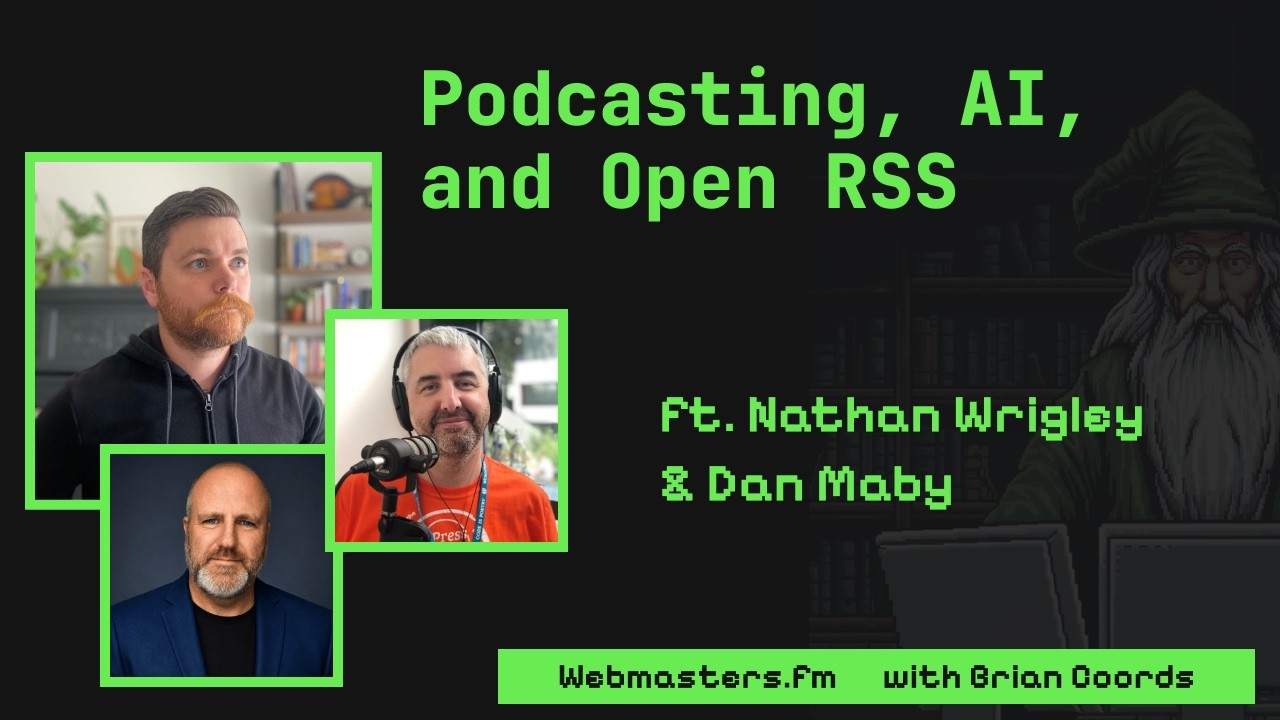
Brian Coords talks with Nathan Wrigley and Dan Maby, co-founders of show.fm, about building a platform that brings podcast planning, booking, publishing, and related workflows together. They explain their human-first approach to AI, commitment to open RSS and creator ownership, and how customer feedback is shaping studio, editing, and distribution features.
Links
Chapters
00:00 Meet Nathan Wrigley and Dan Maby
01:16 The podcast workflow problem behind show.fm
04:20 Helping podcasters get beyond episode three
06:16 Planning and architecture before scaling the product
08:49 How AI fits into development, with human oversight
13:48 AI that supports podcast makers, not replaces them
18:38 Podcasting, WordPress, and open publishing
22:01 RSS, ownership, and the video-versus-audio debate
24:45 Audio-first studio plans and customer feedback
29:29 WordPress distribution, the rebrand, and show.fm’s guest network
Transcript
Brian Coords (00:00)
Welcome to Webmasters FM. Today I have Nathan Wrigley and Dan Maby to talk about show dot FM. And so I’m gonna give both of you a chance to introduce yourself. And I mean, would assume anybody listening to a WordPress podcast probably knows these names, but just in case they don’t, maybe Nathan, you can go first and introduce yourself.
Nathan Wrigley (00:17)
Okay, sure, thank you, Brian. Thanks for having us on. Nathan Wrigley, I have been podcasting primarily in the WordPress space for the last decade. That’s kind of the raison d’etre behind the thing that we’re gonna talk about today. Prior to that, I was kind of a local developer, did WordPress and various different other platforms, websites for people in the local area, and then pivoted somewhat unexpectedly into podcasting. And that really is what I’ve been doing for the last decade. So I’ve been through all of the different pain points.
Nathan Wrigley (00:45)
during the, I think it’s about 1200 episodes I’ve recorded now, something like that.
Brian Coords (00:49)
Wow.
Dan Maby (00:50)
It’s not a not a small number, is it? Brian, thank you. Appreciate appreciate you having us here. I’m Dan Maby. I’ve got near what two decades of development under my belt. I’ve been in the WordPress space. I spend a lot of time predominantly focusing on the community side of WordPress. I’m a big big big fan of the people before technology. but we Nathan and I have had many opportunities to work together, many discussions, and that’s really where our journey together was born.
Dan Maby (01:13)
Out of yeah, the the the community, really.
Brian Coords (01:16)
Nice. And so you both work together on show dot Fm and I feel like I should let you give the pitch, how do you explain this? What what market are you going after? What are you trying to solve here for people?
Nathan Wrigley (01:25)
Hmm, okay. I’ll take it first because essentially the platform is born out of the problems that I have had. Now, it doesn’t matter what industry you’re in, if you do the same thing over and over again, you kind of figure out ways where that system could be improved or that, you know, little set of things that you normally do week in, week out, there’s ways that you can make it better. And so it is with podcasting. It turns out that if you want to do a podcast well, there’s a myriad, maybe there’s a dozen, a couple of dozen different things that you have to do.
Nathan Wrigley (01:53)
one of which is recording, one of which is preparation, one of which is publishing. That might be on a podcast host, that might be on a WordPress website or something like that. And in many cases that required overlapping tools. So think for example, things like Google Docs for show notes or a calendar system, which you had to pay for. And then a hosting plan, podcast hosting plan, differs in its sort of makeup, but is broadly the same as a WordPress hosting plan. You need to put a
Nathan Wrigley (02:19)
blob of data somewhere so that other people can get it. And so show.fm was born out of that, just trying to figure out ways to make the job, the repetitive work of podcasting go away and automate the bits that can be automated and make it so that all of the bits that you can’t automate are at least in one place. So it’s this one platform login and do most of the things that a podcast requires. And that’s probably the summation of it, I would say.
Brian Coords (02:46)
So it was born out of that personal scratch that itch, you’re your first customer mindset.
Nathan Wrigley (02:52)
Yeah, very, very much so. And if you haven’t done a podcast, the description that I just gave is basically accurate. You’ve just, mean, Brian, you can identify the, the tasks themselves are, you know, individually, they’re not all that annoying, but when you add them up and if you’re doing it on a cadence, like I am, I’m producing three to four episodes every single week. The, the dead time is, a little bit annoying. It’s, know, you can see the hours just disappearing to mindless tasks that you really could be automating.
Nathan Wrigley (03:19)
And the ways to do that in the past were cobbled together. So you would have a bunch of zappier things going on over here, which you’d connect to your calendar booking system over there and try to automate all those things. But it was kind of held together with a bit of sticky tape really. But yeah, it is basically born out of the problem that I have. But it’s been nice since we launched the platform to get it into the hands of people and finally to actually realize, it isn’t just me. genuinely is.
Nathan Wrigley (03:45)
this problem because more or less everybody that we showed it to has sort of taken us up on the offer of getting on board the platform. And so that, I guess, speaks to the problem being real for people doing what I do.
Brian Coords (03:58)
Yeah, it’s definitely a real problem. It’s the the podcasting problem where you think, well, I’ll just turn on a camera and I’ll talk. And then there’s just hours of busy work and it’s the same every time. And it’s copying and pasting and you
Nathan Wrigley (04:08)
Yeah. Yeah. Yep.
Brian Coords (04:11)
have four different things you’re signed up for. And you know, you have a calendar link here and some other stuff there. It’s it’s definitely a pain point. What
Brian Coords (04:20)
was the thing that brought the two of you together to say we think this is something we can actually solve and maybe build a business on top of.
Nathan Wrigley (04:27)
So the one sort of weird statistic which keeps getting thrown out there is that a lot of people begin, like many, many, many thousands of people, it probably genuinely is thousands of people a week. I actually don’t know if that’s true, but that kind of order of magnitude doesn’t seem too ridiculous. Begin the podcasting journey and then the number is three. Three episodes in, you kind of hit a brick wall and you give up. And so the idea was to…
Nathan Wrigley (04:53)
is to make it so that people get beyond three, that people get to 10, 20, 100, and rather than giving up because the boring stuff was unexpected to them and therefore something they didn’t really anticipate and wanna get involved in, the idea is to take that away and yeah, make it so that they get pushed through that barrier. And I don’t actually remember, Dan, specifically how we ended up doing this together. We just sort of did.
Nathan Wrigley (05:19)
Do you remember the moment? I can’t exactly remember. Yeah.
Dan Maby (05:19)
We d yeah. with with
Dan Maby (05:24)
doing various things together, various opportunities to work together. But we just sat down and had a conversation about the the challenges that you were facing. Obviously you’d had the the very initial application developed which was suitable for you as an individual, wasn’t it? But of course it was taking that idea and evolving
Nathan Wrigley (05:37)
Kinda.
Brian Coords (05:39)
Mm-hmm.
Dan Maby (05:40)
it into something that could be
Dan Maby (05:41)
delivered to a a mass market. There’s there’s one thing developing a piece of software for an individual and an individual’s workflow, but trying to take that and turn it into something that anybody can use is a very, very different story and a very different journey, which has been it’s been interesting, hasn’t it? We’ve spent we’ve spent several years going through the planning stages of this. there’s been more, much more work gone into the
Dan Maby (06:02)
the planning and the architecture than than the actual development itself. It’s been looking at user journeys, looking at how Nathan works and how others potentially work with it. So it’s been quite a fascinating journey so far. But we realise that we’re
Nathan Wrigley (06:14)
Yeah,
Dan Maby (06:15)
just at the start of it really.
Nathan Wrigley (06:16)
we cracked open a tool. I don’t know if you’ve come across it called Whimsical. We spent a long time in
Brian Coords (06:20)
Mm-mm.
Nathan Wrigley (06:21)
Whimsical. It’s like a wireframe tool. It’s fairly basic,
Brian Coords (06:23)
Okay.
Nathan Wrigley (06:24)
but it allows you to have that infinite canvas that you can zoom in and pinch in and pinch out and all of that. And we must have done hundreds and hundreds and hundreds of those boards trying to figure out what the perfect flow is.
Nathan Wrigley (06:37)
I’m not sure that we’ll ever capture the perfect flow, but we’ve gone through so many iterations of what’s the best thing from this moment to get to this moment, to get to this moment and trying things out in our heads and then trying things out programmatically. And yeah, it’s been, it has been many, many years in the making.
Dan Maby (06:54)
I th I think that’s part of the the the challenges we’re seeing at the moment really with yeah the y the prolification of AI in the development space and how do we
Brian Coords (07:02)
Mm-hmm.
Dan Maby (07:03)
ensure that the products that are produced are scalable, are secure, are well thought through when it comes to things like accessibility and enabling yeah
Dan Maby (07:11)
thousands of users to use that product is yeah, there’s there’s a lot of challenges there that I think unless you have the experience, unless you’ve been through the the journey of software development, the idea of picking up an AI tool and simply throwing something together and then chucking it out on the market really isn’t it’s it’s not something that ne neither Nathan and I are are are particular fans of. It’s you know, it’s about building something
Dan Maby (07:34)
stable for the long term for the future here. This is and that’s really why we’ve structured our our our founders deal because again it was about structuring the business in a way that enables it to be sustainable long term we’re not you know talk we talked about long lifetime deals and various things how to launch the business etc and honestly there’s
Brian Coords (07:51)
Mm.
Dan Maby (07:51)
just so many conversations in that journey that you just don’t expect to have it’s been yeah yeah quite fascinating
Brian Coords (07:58)
you must have started this before AI is what it is today and
Nathan Wrigley (08:04)
Mm-hmm.
Brian Coords (08:04)
before, you know, the idea that, you know, anybody on the street is just gonna launch their own app and, you know, sell software all the way to now software is dead and everybody needs personal software and all the different things. So I’m just curious if that’s affected anything along the journey because I kind of agree that the time you spend planning
Brian Coords (08:25)
thinking about your user experience, actually, understanding the architecture, thinking about scale, all that stuff is not something I don’t think you can prompt your way through that if you haven’t been through it personally, if you haven’t actually, you know, broken a few websites, you know, yourself. so
Nathan Wrigley (08:40)
Yeah. Yeah.
Brian Coords (08:42)
I’m curious if it’s from the moment you started to today, if it feels like there’s just a shift in the culture or even a shift in how you’re working.
Nathan Wrigley (08:49)
So we, so before Dan and I were working on this together, I decided that I would give this a go. Not personally, I hired a developer in the UK, very competent developer, was really great. And had a Laravel app built and kind of ran out of financial resources to push that through. But the idea was to launch something similar to what we’ve got. But that gave us the sort of template to work from, if you know what I mean. So that had.
Nathan Wrigley (09:15)
That was way before AI. So I think that was completed maybe 2018. That’s a guess, but it was around that era, you before there was any AI at all. But it gave us the structure. It gave us an idea of what the app might have as its sort of core component parts. And then more recently, we started building it. think it’s fair to say AI had come along, but I’ll hand over to Dan at this point, because he can answer just how much AI has been used.
Dan Maby (09:41)
Sure. i i i I think in the development cycle the use of AI is a tool. Yeah it it’s something that can be utilized and it’s something that the the the there’s all sorts of arguments around it. I I certainly have some some struggles with some of the cons, you know, the the the the environmental impact, for example, is something that I really struggle with, but
Dan Maby (09:59)
as a tool, you know, if if we’re not utilising these things that we have available to us, do we end up getting left behind? Do we end up you know, there’s there’s there’s all sorts of arguments around it. And unfortunately I’ve sort of
Dan Maby (10:10)
penned myself into this corner of yeah, we’re gonna we’re going to use AI to support the development cycle. It’s something that has enabled us to move forward in ways that we may not have been able to previously, but it hasn’t been a case of you know, here’s a here’s one prompt and off you go and it just builds the thing. It’s been a case of using it for some of the groundwork, some of the some of the stuff, just the busy stuff really that as a developer
Brian Coords (10:30)
Mm-hmm.
Dan Maby (10:31)
we have to take on and have to support when we
Dan Maby (10:34)
when we’re going at a project of this scale, ’cause this is a a sizeable application that we’ve got here. And
Nathan Wrigley (10:40)
Yeah, that’s
Nathan Wrigley (10:40)
true. There’s a lot of hanging, there’s a lot of parts, a lot of tendrils hanging off each other. And I don’t know if an AI agent of any description could actually manage to keep all of that in view.
Brian Coords (10:53)
Hm.
Nathan Wrigley (10:54)
You know, and we’ve been iterating over it fairly recently, like adding in a different set of permutations around teams and roles and permissions and things like that. And that requires Dan to fully understand the underpinnings of that.
Nathan Wrigley (11:07)
before AI can get involved. Otherwise it would be an interesting mess. Let’s put it that way.
Dan Maby (11:12)
Yes. Yeah, map mapping
Dan Maby (11:14)
out that architectural piece has been so critical because we need to understand
Nathan Wrigley (11:16)
Mm-hmm.
Dan Maby (11:17)
the implications of the changes. You know, how we make sure that these the changes that are making, the iterations that we’re making based on the feedback that we’re getting from these from these early users, how do we ensure that those changes don’t introduce breaking changes, you know, don’t make don’t suddenly turn the app upside down and and make it unusable for the end user.
Brian Coords (11:34)
Yeah, and we’re recording this the day after the big PHP security vulnerability thing. And it wasn’t even just PHP. There was so many other pieces of it just I mean it it was like
Dan Maby (11:44)
SSL certificates, yep.
Brian Coords (11:46)
yeah, the SSL, there was I think rail railway, I think was another big one. I mean,
Nathan Wrigley (11:49)
Yeah, railway. Yep. Yep.
Brian Coords (11:51)
it’s just kind of hit everything. And I have to imagine for what you’re looking at, because you’re you know, it looks like
Brian Coords (11:57)
there’s integrations with your social media, maybe your website, you’re hosting files, you have teams, you probably have private notes between, you know, the people running the podcast, all of this information that’s just sitting there. So has that changed how you look at it’s it’s not even the it’s not even just the code you write. It’s AI will love to pull a library from here. I’ll use this for this, and we’ll use this thing for your database and this sort of stuff. And
Brian Coords (12:24)
If you don’t pay attention to it, it’s just going to just grab any random thing. And that’s where it seems like a lot of those security gaps are happening. So I I have to imagine you keep a really close eye on every little piece and spend all that extra time vetting, which is, you know, the job of the developer. And so I’m curious if that’s been part of the conversation.
Dan Maby (12:44)
Absolutely. the dependencies have been b have been critical. How do we make sure that that dependency tree doesn’t as you say it doesn’t grow out into a a forest that we simply can’t manage? Because there’s so many d you’re absolutely right. these AI agents will try and solve the immediate problem that’s in that’s in front of them and not necessarily
Brian Coords (13:02)
Mm-hmm.
Dan Maby (13:03)
always understand the wider scope and the wider
Dan Maby (13:05)
implications of the changes that they’re trying to make or the libraries they’re trying to introduce. So it’s been very much, you know, how do we make sure that we are the I’ve I’ve always been challenging a little bit challenged with the the the term guardrails. Obviously we do need guardrails, but equally I think the guardrails can also become a bit of a problem in their own right because you’re you’re basically
Dan Maby (13:23)
hemming it into your own knowledge and obviously there’s there’s all sorts of things around here that we need to do to explore about if you’re using a tool, do you utilize that tool to its to its maximum? And that starts to get quite you know very complicated because you then start to wander into territory where you’re dealing with technologies that you may not be familiar with, etc. so
Brian Coords (13:42)
Mm-hmm.
Dan Maby (13:43)
it’s it’s it’s definitely been a a a learning journey for us. And we
Dan Maby (13:48)
We actually decided to integrate some AI into the platform as well. we’ve had some very strategic conversations around what does that what does that look like. And we didn’t want to go down the path of producing a product that essentially was just a another AI wrapper that just required a chat input for you to prompt your way through creating a podcast. Podcasts are about people, they’re about connection.
Dan Maby (14:10)
So we wanted to make sure that when we were introducing AI, it was a it’s a thin layer that actually supports the workflow and makes the end result of the podcast better as opposed to becoming the tool that you’re using to create the podcast. I know Nathan, you’ve been quite you’ve been quite strong on the the ideas around AI, haven’t you, with within the podcasting space?
Nathan Wrigley (14:29)
Yeah, I’m
Nathan Wrigley (14:31)
not a big proponent of AI where AI doesn’t actually need to be. I think it’s got its place. It’s marvelous at many, many tasks, but I still enjoy holding a paper book and enjoy going out and seeing an actual band and all of those kinds of things. so for me, making a podcast, a friend of mine actually described the thus, after he had a play with it, he said,
Nathan Wrigley (14:54)
It allows you to concentrate on the artistry of your podcast and gets rid of the tedious bits. It was something along those lines, but it was the word artistry that I really liked. And so you can’t use our platform and just poke an AI at it and say, make me a podcast. Literally nothing will happen. There’s no mechanism to do that. This is about human beings making content just like we’re doing now.
Nathan Wrigley (15:16)
know, editing, improving it in all of those ways, but there are a few little places where we saw, actually, do you know what? There’s a boring bit that we could swap out with AI there. So one example is guest research. So we have a booking system, so imagine Calendly. Calendly,
Brian Coords (15:33)
Mm-hmm.
Nathan Wrigley (15:34)
if you use that, it just creates an event in your calendar. Our platform will create a podcast episode.
Nathan Wrigley (15:39)
which then if the person filling out the booking form answers some questions, which you can turn them all off if you don’t want, but if you want to add the AI questions in, then at the point where you confirm that booking, it will go out on the internet, find public places where that person has put their content, they will provide links in the booking form and so on. And then it will give you a summary of what that podcast episode might look like in text form. know, possible questions, subjects to dig into,
Nathan Wrigley (16:08)
possible icebreakers, things that they’ve done in the past, those kind of things. You the sort of stuff that is, you could do that yourself, you totally could, but we provide a mechanism to just short circuit that. So you don’t even have to do that research. It’ll just drop into your show notes before the show begins. So it’s things like that. Where else do we do? transcripts, I guess, is another
Dan Maby (16:28)
Mm-hmm.
Brian Coords (16:28)
Mm-hmm.
Nathan Wrigley (16:28)
area
Nathan Wrigley (16:29)
of AI because, you know, that’s a fairly normal thing in the world now, isn’t it? Having a transcript done from an audio file.
Brian Coords (16:35)
Yeah, I don’t I can’t wrap my head around the idea of listening to an AI generated podcast, this
Brian Coords (16:42)
take this news article and make a fake podcast. Cause what when I think of the podcast I listen to, it’s almost always the person is like more important than the topic. You’re it’s like,
Nathan Wrigley (16:49)
Yeah. Right.
Brian Coords (16:52)
I want to hear what this person is gonna say about the news this week or about this topic. It’s it’s such a human thing, but there is a lot of spots I I like I applied the same thing to when I’m
Brian Coords (17:02)
writing blog posts for WooCommerce or something, it’s if I go and say, AI, write me this blog post and I’ll edit it later, it’s always garbage. It’s always just I’m fighting against it. If there’s something but if I start with a blank page and I say, well, AI, go find me some interesting links to read or go get, the resources that I already know I need to link to and do some of that grunt work for me, then it’s I I go, okay, I can I can understand that. That makes a little more sense to me. But I’m
Nathan Wrigley (17:28)
it’s really interesting that you say that Brian, because I’ve been fairly introspective about my own podcast consumption recently, just thinking what actually is it that I get out of it? And in many cases, I’ll find that I’ve got to the end of a podcast episode and I genuinely have no idea what they’ve talked about. It was the interplay of the people on the podcast that I found fascinating.
Nathan Wrigley (17:51)
So there’s this one that I listen to every week and it’s the same three characters every week, they show up and talk about tech. And the content itself is like really disposable because tech from this week will be replaced by tech from the next week. But this one character whose name is Jeff, he will get all grumpy and cross and irate and then this other lady
Brian Coords (18:10)
Mm-hmm.
Nathan Wrigley (18:10)
called Paris, she’ll be kind of all outgoing and, you know, just have her own opinions on things. And that’s the bit.
Nathan Wrigley (18:17)
That I think is the bit. That’s why we go and see bands. That’s why we turn up for lectures. That’s why we tune into television programs, because we want that sort of relationship. And
Dan Maby (18:26)
Mm.
Nathan Wrigley (18:27)
it’s really hard to put your finger on that. And I don’t know if I did a great job of explaining what the contents of my head is there, but I hope that you got it a little bit. And that’s the bit. That’s the bit that makes podcasting so interesting.
Dan Maby (18:38)
I th I I think we’ve we’ve spoken about this a couple of times, Nathan, haven’t we? This this idea of coming together across WordPress and the ability to publish your content online, get your get your word out there. podcasting just sits right in that same space as well, that ability to get your message out. if you don’t have the opportunity to produce a website, the ability to simply record some audio and publish it somewhere online. It it’s a it’s there’s a lot of similarity between that sort of WordPress world and the podcast world.
Dan Maby (19:03)
that we’re we’re traversing between at the moment.
Nathan Wrigley (19:05)
When I was a kid, I don’t know how old you are, Brian. I suspect you’re quite a bit younger than I am. But when I was a kid, know, things like Star Trek were on telly and I was in bands and we had recording bands was just so really difficult. know, somebody had to have this extraordinarily expensive piece of kit and then you had to lug
Brian Coords (19:25)
Mm-hmm.
Nathan Wrigley (19:26)
it somewhere and, you know, somebody had to give up their garage and all of that. What I’m trying to say is audio recording.
Nathan Wrigley (19:31)
was a nightmare, distribution impossible, completely impossible
Brian Coords (19:35)
Mm-hmm.
Nathan Wrigley (19:36)
unless you totally locked out and got discovered by some, some recording guy in a pub, then there was no way you could be distributed. Now, you just turn on your mobile phone, record 15 minutes of audio, upload it to an audio host and the world can see it. you know, there’s a difference between the quality of what people produce and how far it reaches.
Nathan Wrigley (19:59)
But that is the promise that brought me into WordPress. It’s that zero entry barrier. So long as you’ve got, a few dollars, I guess is the real barrier for the hosting. But once you’ve come over that barrier, type the words, click publish. In this case, record the words, click publish. And it’s just so amazing. I love it.
Brian Coords (20:18)
Yeah, there’s there’s a thing that WordPress and podcasting, I think, both have in common too, which is that there’s there’s easier ways to do it by going through proprietary platforms. You can I’m sure
Nathan Wrigley (20:28)
Yeah, yeah.
Brian Coords (20:29)
Spotify makes it very easy to use their platform. That’s like the square space of podcasting, maybe. But there’s something about WordPress and podcasting culture that is always fighting for the open protocols. And it’s like everything’s a little bit harder, but
Brian Coords (20:45)
You it’s it’s a lot harder to get a podcast set up when you go that route and do it yourself and where do you put the files because they you need good hosting for that and blah, but it’s something about being able to at the end of it say, Well, I own this URL, anybody can visit it, anybody can get this content, you can’t prevent me from showing up, you can’t prevent a user from getting it in their podcast app. Like there’s just something about the WordPress and podcast, you know, the RSS feed.
Brian Coords (21:13)
layer that we all just rally around and I feel like that’s this important thing that I I hope sticks around even while podcasting has turned a little bit into, you know, famous actors and all you know, it’s on Netflix now
Nathan Wrigley (21:24)
Yeah.
Brian Coords (21:25)
and there’s all this other side of it. It’s like we’re still keeping the core of like, no, the the goal of this was just, you know, I guess democratizing publishing to some extent.
Dan Maby (21:33)
Yeah,
Nathan Wrigley (21:34)
So there’s a really
Dan Maby (21:34)
absolutely.
Nathan Wrigley (21:34)
curious thing that happened. You remember online, know, a few people were blogging, but it wasn’t a lot of people. And then the proprietary platforms came along and sort of gobbled up the blogging space and everybody got a Facebook account and Twitter and all of these different things. So it happened that way around. You could publish and then these platforms dropped in and everybody did it that way. With podcasting, it’s the other way around. The podcasting industry is already established.
Nathan Wrigley (22:01)
and now the big players are coming in and trying to gobble up what is already there. And it’s a real debate in podcasting at the moment. Like is a YouTube channel a podcast?
Brian Coords (22:12)
Mm-hmm.
Nathan Wrigley (22:13)
And some people would say, you you might describe them as purists, would say no, because there’s no RSS feed, which essentially is really what a podcast is. Other people would say, yeah, it’s irrelevant. So long as there’s content, be it audio or video that’s deliverable.
Nathan Wrigley (22:28)
That’s a podcast, but Dan and I are firm, well, I speak for myself, I’m pretty sure that Dan is too.
Dan Maby (22:33)
Mm-hmm.
Nathan Wrigley (22:34)
We’re firmly in the open access to your own data camp. If you bring and host with us, we don’t claim it as ours. We don’t claim the ownership of any of that. If you want it back, you can have it back in a heartbeat. We keep the original files so that you can get those back whenever you want them. There has to be a sort of proprietary layer, which is the hosting bit, because we’ve got to do that.
Nathan Wrigley (22:56)
in order to get it hosted. But we believe that that content is yours. And if you want it back at any point, that should be trivially easy to do.
Dan Maby (23:04)
Yeah, that that that’s the backbone of podcasting, isn’t it? The RSS. That’s really where the focus needs to be. and and podcasting two point the tags there are are incredible. From a t if we start to look at the more technical aspects of it, there’s some really great opportunities developing when we’re looking at the two point solutions. and we’re again we’re we’re implementing as many of those as practically possible across the platform and enabling that that that freedom of information, that freedom of of of content.
Dan Maby (23:30)
Distributed across the internet.
Nathan Wrigley (23:32)
you
Brian Coords (23:32)
Yeah, I’ve been
Brian Coords (23:33)
exploring this because I make video of this podcast because Riverside FM records the video. And every time I talk to somebody, I go, I don’t really want to post the video. And they go, Well, you should post the video. It’s good for exposure and reach. But I don’t like to watch video pod. I just I’m I’m audio all the time. I love the audio experience. Walking the dog,
Nathan Wrigley (23:51)
Yeah, me too. Yeah. Yeah.
Brian Coords (23:53)
get the audio podcast. And so I kind of go back and forth on that. But it seems like with
Brian Coords (23:58)
What happened is YouTube ate a little bit of that, but then there is this podcast two point thing about getting, you know, more video into the feeds, self-hosting your video somewhere. even in inside our company at Jetpack, they’ve been pushing into podcasting more and kind of saying, wow, we have all these tools, but we’ve never really packaged it in an easy way. So they’re trying to work on that. And I’m curious how much you’re looking at some of the things like video, like paid podcasts, private RSS feeds.
Brian Coords (24:26)
Or monetization links or some of that stuff, because it is true that with podcasting, like you said, a thousand people might start three episodes in, they’re gonna probably die off unless they’re just doing it for the love of the game. So I’m curious how you’re looking at some of those other things that have creeped in but are also maybe important for the community as well.
Dan Maby (24:45)
Yeah, these things are it’s really interesting actually the conversations that we’re having with our customers the having recently launched, discussing what are their pain points, what are they needing to accomplish, how are they looking to use the platform, what features are they looking to for across the platform. we started some work must have been free four or five months ago, we started the actual development of our studio.
Dan Maby (25:06)
the studio and an editing sys editing system so two separate projects that are taking place concurrently and that’s really looking at audio first but of course we’re having these conversations with our customers to determine the level of intent around video because the studio for example allows you to have video. Yeah we can record the video that’s not that’s not a challenge for us but it’s whether or not the customers
Dan Maby (25:29)
genuinely need that, whether the customers are genuinely looking to use that as a tool, because it does change what you do. If you’re ch if you’re switching over to video, we’ve got to make sure the environment looks nice. You’ve got to make sure that
Nathan Wrigley (25:37)
it’s huge. Yep.
Dan Maby (25:39)
the the the editing is right. There’s so many more steps that video brings to the production of a podcast.
Nathan Wrigley (25:45)
I’m like you, Brian, I am 100 % audio. Because for me, the consumption of podcasts happens during those bits of the day where I’m kind of doing other things, but my ears are open, but my hands are engaged in something else and my eyes are engaged in something else. So I don’t know, I might be vacuuming the floor or washing
Brian Coords (26:04)
Mm-hmm.
Nathan Wrigley (26:05)
the car or whatever it may be. And it’s just the perfect medium for that.
Nathan Wrigley (26:08)
However, what’s happening, and I don’t know if you’ve seen, I’m sure you’ve seen this trend, is that the distinction between TV and podcasting is slowly disappearing. So some of the sort of more high-end, I’m doing air quotes, podcasts, the production value is just like a TV show. They’ve obviously built a studio space, they’ve got multiple cameras, they’ve obviously got some sort of editor.
Nathan Wrigley (26:33)
going on in the background, a producer and a script and all of that. So I don’t know whether that’s a podcast. It is, I’m sure it is. But the other curious thing about that is that when you drop things into YouTube, you’ve got that whole algorithm thing going on, where you finish one thing and it serves you up another thing. There’s no mechanism in podcasting to do that. Individual podcast apps, Automatic owns one called Pocket Casts as an example, that will offer up.
Nathan Wrigley (27:00)
a selection of things that you might like to try, only in its own little silo and not everybody’s using Pocket Cast. So I feel like there’s a real, well, battleground is the wrong way to describe it, but I do feel that the video side of things and the audio side of things, there’s gonna be a collision at some point. For me, I’m gonna be happy doing audio for the rest of my time. I’m totally happy that that market is big enough, that listenership is big enough, there’s enough people walking the dog and…
Nathan Wrigley (27:27)
vacuuming the floor and all of those kinds of things to make it work. And I do wonder sometimes if the data that comes out of YouTube is a little mysterious, let’s put it that way. Those downloads, that
Brian Coords (27:37)
Mm-hmm.
Nathan Wrigley (27:37)
like, is a listen? And that’s a whole other thing in the podcast industry, know, what makes a listen.
Dan Maby (27:41)
It is.
Nathan Wrigley (27:43)
And you ask 20 different podcast hosting companies what a listen is and you’ll get 40 different answers.
Dan Maby (27:50)
Ha
Dan Maby (27:51)
ha ha.
Brian Coords (27:51)
Yeah, I I I have a lot of feelings and they don’t make I haven’t I don’t have a good theory of what’s going on with podcasting and how it’s sort of turned into like talk shows, basic. It’s kind of turned into daytime TV mixed with podcasting. I
Nathan Wrigley (28:03)
Yep. Right. Yep.
Brian Coords (28:07)
to bring back what you were talking about earlier, when
Brian Coords (28:10)
How it used to be so hard to record audio. And then I feel like Garage Band, when I was young, that was a big deal. That when we had garage band and we could make our own songs and it didn’t sound good. The quality was still pretty bad because our gear wasn’t good. But it just opened up a thing where it was, you know, anybody can do this. I don’t have to do it with a bunch of money. And I feel like that’s kind of that’s kind of what I’m I’m really most excited about is just this idea that we can.
Brian Coords (28:36)
we can find ways for everybody to kinda communicate these things. And so
Nathan Wrigley (28:39)
Yeah,
Dan Maby (28:39)
Mm-hmm.
Dan Maby (28:40)
Yeah.
Nathan Wrigley (28:41)
yeah, you’ve hit the nail on the head and that’s what our app does enable it. GarageBand would be a really nice metaphor for it really in a way. know, along comes a tool which made that thing, getting that band recorded suddenly possible. That’s a little bit like what our app is. You know, it enables you to do a whole bunch of things around the podcast that you wanted to produce in this one app. And you don’t…
Nathan Wrigley (29:05)
I feel that like if you’re chasing the 10,000, 50,000, 100,000 downloads, maybe there’s a question mark that you should be, know, question that you should be asking yourself, am I in it for the right reasons? If it is to become famous, okay, great, but you might not be famous. Just don’t give up at three, just get to 20 or something. Give it a fair try, you know.
Dan Maby (29:25)
Yeah.
Brian Coords (29:26)
So go ahead.
Dan Maby (29:29)
I all all I was just gonna say there was just bringing it back to the the the the the website side, the the web development side and bringing back the this idea of content and getting your content distributed. ’cause it’s it’s it’s one thing obviously recording it and then it’s getting it out there and and getting that hundred thousand listeners. How do you how do you accomplish that? and I think all of that comes back to enabling
Dan Maby (29:47)
your message, getting your message across and enabling people to be aware of of your content. obviously both Nathan and I and yourself, Brian, obviously all big fans of WordPress over the years. We’ve been very heavily involved in various ways. so we we developed a WordPress plugin that enables us to enables our our customers to very easily distribute that content that they host on show dot fm across their WordPress site as well.
Brian Coords (30:09)
Nice. So I guess w I wanna give you a last chance to tell everybody where to go and kind of where to sign up for. because I think if you are getting into podcasting, this is something where you can it can really get you past the stuff we all used to have to figure out manually. All that
Nathan Wrigley (30:26)
Mm-hmm.
Brian Coords (30:26)
all that work, that’s kind of what you’re getting out of the way. But I have to ask how you got that domain name because that is such a good domain name. I’m guessing you had to get in early on that.
Nathan Wrigley (30:35)
such a great story and it’s not even a story. There’s no story there. It was just there. It was just available. Yeah.
Brian Coords (30:40)
It was just there.
Dan Maby (30:40)
We so
Dan Maby (30:42)
it came from having a conversation about the public websites that cause originally this product was called Podcaster Plus and we deliver we’ve produced pub Podcaster Plus blocks, there’s a WebPress plugin specifically for that, and this whole product was going to be Podcaster Plus. and it was only about two weeks prior to our public launch. We sat down and we talked about the public-facing websites that you had within Podcaster Plus.
Dan Maby (31:08)
And it was a subdomain of Podcaster Plus forward slash podcast name, forward slash an episode. And before you know it, you’ve got these massive, great, big long titles. And we said, look, can we do something about specifically that piece of the app? Can we do a short URL? Because the the audio only podcasts, etc. If you just if you want to mention your website, show.fm, nice and short. But if you would listen.podcaster plus dot com forward slash before
Nathan Wrigley (31:32)
even say it.
Brian Coords (31:33)
Yeah.
Dan Maby (31:34)
you know it, you’re stumbling over words and you’re not so.
Dan Maby (31:36)
We went down a bit of a rabbit hole, looking for something short just for that piece that we just do like a yeah, a bitly type solution. And before we know it, we’re doing a full rebrand of the product two weeks before launch. So it was
Nathan Wrigley (31:49)
It was basically
Brian Coords (31:49)
It’s
Nathan Wrigley (31:50)
when I met you in WordCamp US a a couple of months ago now or something,
Dan Maby (31:53)
But yeah.
Nathan Wrigley (31:55)
just like a couple of days before that, Dan had, was it that week? Yeah, Dan
Dan Maby (31:57)
It was that week, wasn’t it? Yep.
Nathan Wrigley (32:00)
had stumbled across this domain name, which just was sitting there, just, you know, it wasn’t even like a reseller thing. It was just available on the market. So we took that as a bit of you know, a bit of serendipity going on there. We were looking for something just like that and there it was.
Nathan Wrigley (32:15)
And yeah, it was acquired and here we are.
Dan Maby (32:19)
It it did. It
Dan Maby (32:20)
it led into some interesting bits though because we were looking at the obviously the as we mentioned the backbone for podcasting is RSS. And we
Brian Coords (32:26)
Mm-hmm.
Dan Maby (32:27)
were going through this concept of a rebrand. this idea, yeah, we obviously weren’t we weren’t public yet. We weren’t you know, we didn’t we had BC testers, but we didn’t have public users using the platform. So we were at a really nice stage to ha to go through that process and it was painful, but we got there. But the bit that was really sticking out to us was the RSS feed and we sat there and said, Well, what if
Dan Maby (32:45)
What if we need to go through a rebrand at some point in the future? What if there needs to be changes to the you know to the the the domain? And the bit that kept coming back was that RSS. And we said, actually, you know what? That needs to be separate. So we actually ended up getting CDN.media as our so we use cdn.media as our RSS feed. So it sits there. It’s a technical thing that 99.9%
Nathan Wrigley (33:04)
Dan is so proud of that. He loves that domain.
Brian Coords (33:08)
Man.
Dan Maby (33:10)
of users will never ever give give
Dan Maby (33:12)
give a monkeys about, but honestly it meant that we’ve got that ability then to have that longevity with that with that RSS feed.
Brian Coords (33:19)
Yeah, those are good domains.
Nathan Wrigley (33:19)
It’s quite nice,
Nathan Wrigley (33:20)
as an example, so we offer, it’s like a subdomain. So let’s say for example, you were going with just the word webmasters for your show. If you brought it over to show.fm, you could have webmasters.show.fm. That would be your home on the platform. that kind of fits, I don’t know, in many cases I think that works quite well.
Brian Coords (33:41)
Yeah.
Nathan Wrigley (33:42)
So you know, my…
Nathan Wrigley (33:43)
WordPressy one is WP Builds. So that’s now WPBuilds.show.fm and it’s catchy, I suppose. It’s pretty good and easy to say out loud in a podcast, for example. Yeah.
Brian Coords (33:54)
So people should go to show dot Fm to sign up and I’m guessing there’s a free trial or some way that they can kind of get an e an experience of what it would look like, maybe pull in their current podcast and get a sense of what that would look like.
Dan Maby (34:08)
Yep. Yeah, we’ve got a a free account available on there as well. but I just want to mention we’ve also got for up until the thirty first of October, we’ve got our founders deal available as well. so we will be we will be closing that on the thirty first of October. But we’re offering three years of access to the platform under that one founders deal and it works out just insanely cheap when you start to break down the the three years of access that that’s offering.
Nathan Wrigley (34:31)
Yeah, we’re looking for a, somewhere in the region of a hundred people just to shape the platform and give us some feedback. We’ve got quite a few on boarded and they’re being very good and telling us where, you know, things they think things should be and how changes could be made or features that we don’t yet have could be brought in. but yeah, this founders deal with, you know, that’s the purpose just to get some onboarding. I would say as well, if you don’t have an interest in having a podcast, you can also sign up and be in what
Nathan Wrigley (34:57)
what is our guest network? So let’s say for example, you have a WordPress plugin and you would like to be on podcasts. You can sign up, it’s completely free, it takes minutes. You fill out a few form fields, that’s your profile. You then check a box, toggle something on basically, and that then will go into our guest network. And then that means that people who have podcasts in our platform can go to the guest network, search for people based upon, you know.
Nathan Wrigley (35:23)
WordPress or web development or crochet, Cricut, whatever it may be. And then with a couple of clicks, can be invited onto, they can invite those guests onto your podcast. So for anybody out there doesn’t want to make a podcast, but would like to be on them, that’s worth looking at as well.
Brian Coords (35:38)
Awesome. Well thank you guys for hanging out and I’m just I feel honored to get to talk to some WordPress legends and just thank you guys.
Nathan Wrigley (35:46)
no, I don’t know what to say to that. But thank you. That’s very kind.
Brian Coords (35:47)
Ha ha ha
Dan Maby (35:50)
Brian, appreciate it. It’s been it’s been a pleasure chatting with you. So thank you very much for your time.
Nathan Wrigley (35:53)
Yeah, lovely.
Nathan Wrigley (35:54)
Thank you, Brian. Cheers.